
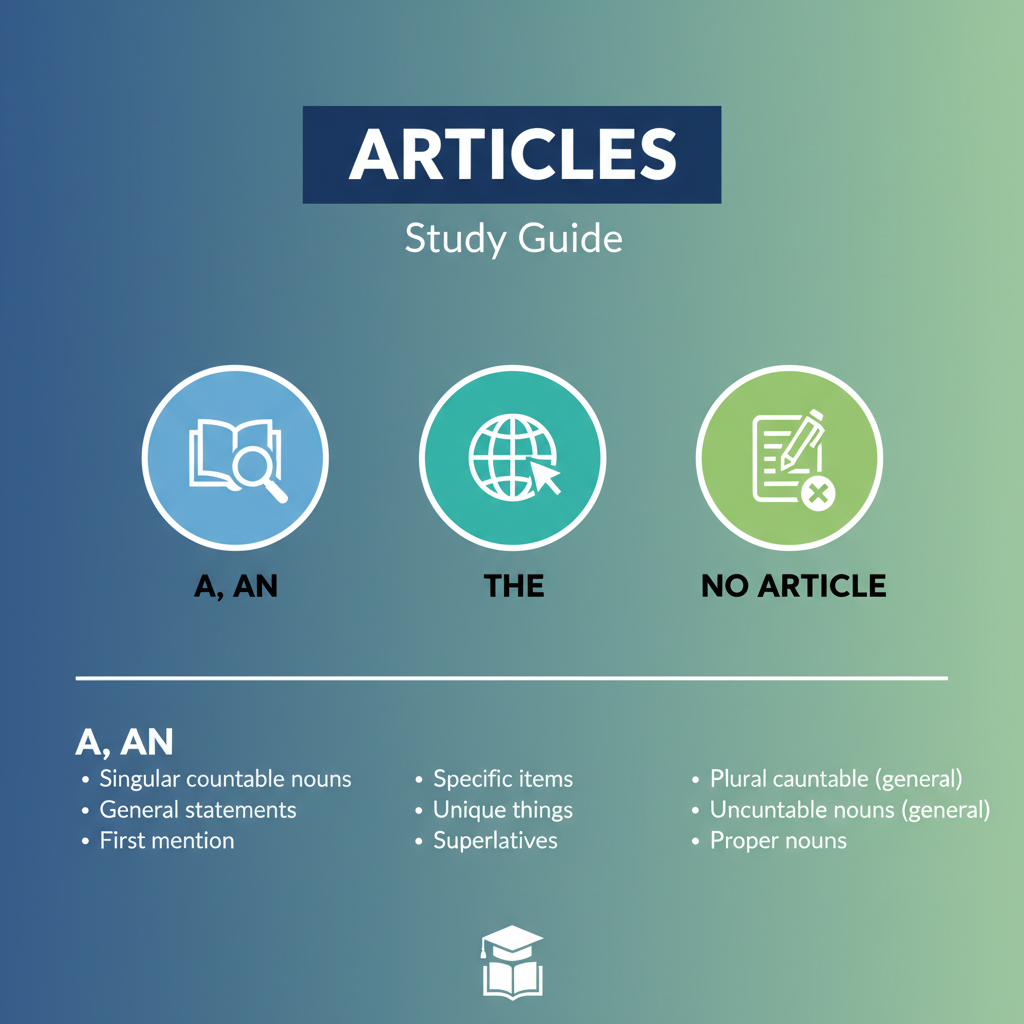
Articles (A, An, The): Mastering the Fundamentals for JKSSB and Other Competitive Exams
Target Audience: JKSSB and other competitive exam aspirants.
Introduction
In the vast landscape of the English language, articles – ‘a’, ‘an’, and ‘the’ – are deceptively small words that play a crucial role in shaping meaning and grammatical correctness. While they may seem elementary, their precise and appropriate usage is a common stumbling block for many competitive exam aspirants. A thorough understanding of articles is not just about identifying errors; it’s about conveying clarity, specificity, and proper sentence structure – all vital skills assessed in exams like the JKSSB.
This comprehensive guide will delve into the nuances of articles, providing a detailed explanation, key facts, numerous examples, exam-focused points, practice questions, and FAQs to equip you with the mastery needed to ace the English section of your competitive exams.
Concept Explanation: What are Articles?
Articles are a type of determiner that precede a noun to indicate whether the noun is specific or general. They are broadly categorized into two types:
- Indefinite Articles: ‘a’ and ‘an’
- Definite Article: ‘the’
Let’s explore each category in detail.
1. Indefinite Articles: ‘A’ and ‘An’
Indefinite articles refer to a non-specific or unidentified noun. They indicate that the noun is one of many, or that its exact identity is not important or unknown to the listener/reader.
Usage Rules for ‘A’ and ‘An’:
The choice between ‘a’ and ‘an’ depends entirely on the sound of the word immediately following the article, not its spelling.
- Use ‘a’ before words that begin with a consonant sound.
- Examples: a book, a table, a lamp, a university (sound of ‘yoo’), a one-rupee coin (sound of ‘w’).
- Use ‘an’ before words that begin with a vowel sound.
- Examples: an apple, an elephant, an hour (sound of ‘ow’), an honest man (sound of ‘o’).
Key Facts about Indefinite Articles:
Used with Singular Countable Nouns: ‘A’ and ‘an’ are always used with singular nouns that can be counted (e.g., a chair, an idea). They are never* used with plural nouns or uncountable nouns.
- Incorrect: a chairs, an advices
- Correct: a chair, some chairs, some advice
- Introducing a New Noun: They are often used to introduce a noun for the first time.
- Example: I saw a dog in the park. (The dog was barking loudly.)
- Referring to Any Member of a Group: They can refer to any one particular item from a group or class.
- Example: I need a pen. (Any pen will do.)
- Expressing Quantity (One): They can imply “one.”
- Example: She has a brother. (She has one brother.)
- In Expressions of Frequency or Rate:
- Example: twice a week, 60 miles an hour.
- In Exclamations with Singular Countable Nouns:
- Example: What a beautiful day! What an amazing performance!
- Before Adjectives Describing Countable Nouns: When an adjective precedes the noun, the article agrees with the sound of the adjective.
- Example: an interesting book, a green apple.
- Special Cases (Abbreviations/Acronyms): The sound rule applies to initialisms and acronyms.
- Example: an MP (M sounds like ’em’), a NATO summit (N sounds like ‘en’).
2. Definite Article: ‘The’
The definite article ‘the’ refers to a specific or already known noun. It indicates that the noun’s identity is clear and understood by both the speaker/writer and the listener/reader.
Key Facts about Definite Article:
- Used with Both Singular and Plural Nouns: Unlike indefinite articles, ‘the’ can be used with both singular and plural countable nouns, as well as uncountable nouns.
- Examples: the book, the books, the water, the information.
- Referring to Something Already Mentioned: When a noun has been mentioned before, ‘the’ is used to refer to it again.
- Example: I saw a dog in the park. The dog was barking loudly.
- Referring to Something Unique or One of a Kind:
- Examples: the Sun, the Moon, the Earth, the Himalayas, the Ganges.
- Referring to Specific Objects/People That are Obvious to Both Parties:
- Example: Please pass me the salt. (It’s understood which salt is being referred to: the one on the table.)
Example: Where is the principal? (The principal of this* school.)
- Before Superlative Adjectives:
- Examples: the tallest building, the most intelligent student.
- Before Ordinal Numbers:
- Examples: the first chapter, the second World War.
- Before Names of Rivers, Seas, Oceans, Mountain Ranges, Deserts, Groups of Islands:
- Examples: the Indus River, the Arabian Sea, the Atlantic Ocean, the Alps, the Sahara Desert, the Maldives.
- Before Names of Famous Buildings, Monuments, Hotels, Museums, Ships:
- Examples: the Taj Mahal, the Red Fort, the Hilton, the Louvre, the Titanic.
- Before Names of Newspapers, Magazines (usually), and Holy Books:
- Examples: the Times of India, the Economist, the Quran, the Bible.
- Before Names of Musical Instruments:
- Examples: He plays the guitar. She can play the piano. (When referring to the instrument in general, as a category.)
- Before Adjectives to Represent a Class of People:
- Examples: the rich, the poor, the educated.
- Referring to a System or Service:
- Examples: the internet, the post office, the electricity.
- With Plural Family Names: To refer to the entire family.
- Example: the Sharmas, the Khans.
- With Nationality Adjectives Ending in -sh, -ch, -ese, when referring to the whole population:
- Examples: the English, the French, the Japanese. (But: an Englishman, a Frenchwoman).
Omission of Articles (Zero Article)
Sometimes, no article is used before a noun. This is called the ‘zero article’.
When to Use the Zero Article:
- Before Plural Countable Nouns used in a General Sense:
- Example: Dogs are loyal animals. (Not ‘The dogs’ because it refers to dogs in general.)
- Before Uncountable Nouns used in a General Sense:
- Example: Water is essential for life. (Not ‘The water’ unless referring to specific water.)
- Example: I like music.
- Before Proper Nouns: Generally, names of people, continents, countries (except those with plural names like ‘the USA’, ‘the Netherlands’, or those containing ‘Republic’, ‘Kingdom’, ‘States’), cities, individual mountains, lakes, and islands do not take articles.
- Examples: Amit lives in Delhi. Asia is a large continent. Mount Everest is the highest peak. Lake Dal is beautiful.
- Before the Names of Meals (Breakfast, Lunch, Dinner):
- Example: We had dinner at 8 PM. (However, if the meal is specific: ‘The dinner we had last night was delicious.’)
- Before Names of Sports and Games:
- Example: He plays cricket. She loves basketball.
- Before Languages:
- Example: He speaks Hindi and English.
- Before Academic Subjects:
- Example: She is studying Physics and Chemistry.
- Before Diseases (most of them):
- Example: He suffers from cancer. (Exceptions: the flu, the measles, the mumps.)
- Before Nouns referring to institutions (school, college, hospital, prison, church) when their primary purpose is being referred to:
- Example: He went to school. (As a student)
- Example: His father went to the school to meet the principal. (Not for its primary purpose as a student).
- In certain fixed expressions and idioms:
- Examples: by car, on foot, at home, in bed, at work, in fact, out of order.
- Before Punctuation marks, numbers, or single letters/symbols (when referring to them as such):
- Example: Add a comma, not a semicolon.
Exam-Focused Points for JKSSB and Similar Exams
- Sound Rule is Paramount: Remember that the choice between ‘a’ and ‘an’ depends on the sound of the next word, not the spelling. This is a common trap.
- Common Mistakes: ‘a hour’ (incorrect, should be ‘an hour’), ‘an unison’ (incorrect, should be ‘a unison’).
- Countable vs. Uncountable Nouns:
- Indefinite articles (a/an) are ONLY for singular countable nouns.
- Uncountable nouns (information, advice, water, furniture) generally take ‘the’ if specific, or no article if general.
- Plural nouns generally take ‘the’ if specific, or no article if general.
- General vs. Specific: This is the core distinction between indefinite and definite articles. Practice identifying whether the noun being referred to is general or particular.
- “I want a cup of coffee.” (Any coffee)
- “I want the cup of coffee that you just made.” (Specific coffee)
- Repeat Reference: Once introduced with ‘a’ or ‘an’, subsequent references to the same noun use ‘the’.
- “I saw a cat. The cat was black.”
- Unique Nouns: ‘The’ is almost always used with nouns that are unique or one of a kind globally (Sun, Moon, Earth) or within a context (the principal, the only way).
- Place Names and Geographical Features:
- No Article: Continents, countries (mostly), states, cities, individual mountains, single islands, individual lakes.
- ‘The’ Article: Mountain ranges (the Himalayas), groups of islands (the Andaman and Nicobar Islands), rivers (the Jhelum), seas (the Arabian Sea), oceans (the Indian Ocean), deserts (the Thar Desert), canals (the Suez Canal).
- Institutions (School, Hospital, Church, Prison):
- No article when referring to the primary purpose (e.g., He goes to school to study).
- ‘The’ when referring to the building or a visit for a different purpose (e.g., His mother went to the school to pick him up).
- Professions/Occupations:
- “He is a doctor.” (Indefinite articles used with professions).
- Nationality Adjectives:
- “He is an Indian.” (Individual)
- “The Indians are known for their hospitality.” (Group)
- Abstract Nouns: Generally take no article when used in a general sense.
- Example: Honesty is the best policy.
- (But: The honesty of the witness was questioned.)
- Superlatives and Ordinals: Always use ‘the’.
- Fixed Expressions: Memorize common fixed expressions where articles are always present or always absent (e.g., ‘in a hurry’, ‘at last’, ‘by bus’, ‘on demand’).
Practice Questions
Instructions: Fill in the blanks with ‘a’, ‘an’, ‘the’, or ‘X’ (for no article).
- He is ___ honest man.
- ___ Sun rises in ___ east.
- She wants to be ___ engineer.
- ___ advice he gave was very helpful.
- Do you like ___ coffee?
- ___ dog is ___ faithful animal.
- We visited ___ Taj Mahal last year.
- ___ Europe is ___ large continent.
- ___ United States of America is a powerful country.
- Can you pass me ___ sugar, please?
- ___ Gandhiji was ___ great leader.
- He bought ___ new car yesterday. ___ car is red.
- She plays ___ piano beautifully.
- ___ Jammu and Kashmir is a beautiful region.
- ___ water in this bottle is cold.
- What ___ beautiful flower!
- ___ knowledge is power.
- My brother goes to ___ hospital every day as ___ doctor.
- ___ English speak ___ English.
- He lives in ___ small village near ___ River Jhelum.
Answers to Practice Questions:
- an
- The, the
- an
- The (specific advice)
- X (coffee in general)
- A (Dog in general, representing the species), a
- the
- X, a
- The
- the (specific sugar on the table)
- X, a
- a, The
- the (general reference to playing the instrument)
- X (J&K is a proper noun, though it is a group of regions, it’s treated as a single political entity name)
- The (specific water in the bottle)
- a
- X (knowledge in general)
- the (as a building for purpose other than a patient), a
- The (people), X (language)
- a, the
Frequently Asked Questions (FAQs)
Q1: What’s the main difference between ‘a/an’ and ‘the’?
A1: ‘A’ and ‘an’ are indefinite articles, used for non-specific or general nouns (e.g., “I saw a dog”). ‘The’ is the definite article, used for specific or already known nouns (e.g., “I saw the dog I told you about”).
Q2: When should I use ‘an’ instead of ‘a’?
A2: Use ‘an’ before words that begin with a vowel sound, regardless of spelling. For example, ‘an hour’ (h is silent, starts with ‘o’ sound), ‘an MBA’ (M sounds like ’em’).
Q3: Can I use articles with proper nouns?
A3: Generally, no. Names of people, continents, countries (with exceptions like ‘the USA’, ‘the UK’, ‘the Netherlands’), cities, individual mountains, and lakes do not take articles. However, ‘the’ is used with mountain ranges, groups of islands, rivers, seas, oceans, famous buildings, and plural family names (e.g., the Himalayas, the Taj Mahal, the Guptas).
Q4: Do articles go before abstract nouns like ‘love’, ‘happiness’, ‘information’?
A4: Usually, no article is used when abstract nouns are used in a general sense (e.g., “Love is blind.”). However, if you are referring to a specific instance of an abstract noun, ‘the’ can be used (e.g., “The love he showed was immense.”). Uncountable nouns like ‘information’ and ‘advice’ also follow this rule.
Q5: What about countable and uncountable nouns?
A5:
Countable Nouns (singular): Must have ‘a’, ‘an’, or ‘the’. (e.g., a car, the* car).
Countable Nouns (plural): Take ‘the’ if specific, or no article if general (e.g., the books I read, Books* are good).
Uncountable Nouns: Take ‘the’ if specific, or no article if general (e.g., the water in the bottle, Water* is essential). You can’t use ‘a’ or ‘an’ with uncountable nouns.
Q6: Are there any common errors related to articles in competitive exams?
A6: Yes, some common errors include:
- Confusing ‘a’ and ‘an’ (e.g., ‘a honest man’).
- Using ‘a/an’ with plural or uncountable nouns.
- Omitting ‘the’ before superlatives or ordinal numbers.
- Incorrectly using ‘the’ with general plural or uncountable nouns.
- Misusing articles with geographical names or institutions.
Q7: How can I improve my article usage for exams?
A7:
- Read Widely: Pay attention to how articles are used in well-written English texts (newspapers, magazines, reputable websites).
- Practice: Do as many practice questions as possible.
- Review Rules: Regularly revisit the rules, especially the exceptions and special cases.
- Listen Carefully: Notice article usage in spoken English from native or proficient speakers.
- Self-Correction: When you write, consciously check your article usage.
Conclusion
Mastering articles is more than just memorizing rules; it’s about developing an intuitive understanding of specificity and generality in English. For JKSSB and other competitive exams, this nuanced understanding translates directly into higher scores in the English section. By diligently studying the concepts, practicing with varied examples, and focusing on the exam-relevant points outlined above, you can confidently navigate the challenges posed by articles and enhance your overall English proficiency. Keep practicing, and success will surely follow!
