
Mathematics is an indispensable part of almost all competitive examinations, and topics like Profit and Loss are fundamental. For exams like JKSSB Forester, understanding these concepts is not just about memorizing formulas, but about grasping the logic behind them. This detailed guide will equip you with the knowledge and strategies to confidently tackle Profit and Loss questions.
Introduction: The Essence of Profit and Loss
At its core, Profit and Loss deals with transactions involving buying and selling. Whether it’s a shopkeeper selling goods, a company trading stocks, or even an individual selling an old item online, the principles of profit and loss come into play. Understanding these principles allows us to calculate how much money is gained (profit) or lost (loss) in a transaction. This topic is not just academic; it’s a practical skill applicable in everyday life. In competitive exams, questions on Profit and Loss test your ability to apply mathematical concepts to real-world scenarios, often involving percentages, ratios, and basic algebra.
Core Concepts: The Building Blocks
Let’s break down the essential terminology and concepts that form the foundation of Profit and Loss.
- Cost Price (CP): This is the price at which an article is purchased. It represents the actual expenditure incurred by the seller to acquire the product.
Example:* If a forester buys saplings for planting at ₹10 each, then ₹10 is the Cost Price per sapling.
- Selling Price (SP): This is the price at which an article is sold.
Example:* If the forester later sells mature trees for ₹500 each, then ₹500 is the Selling Price per tree.
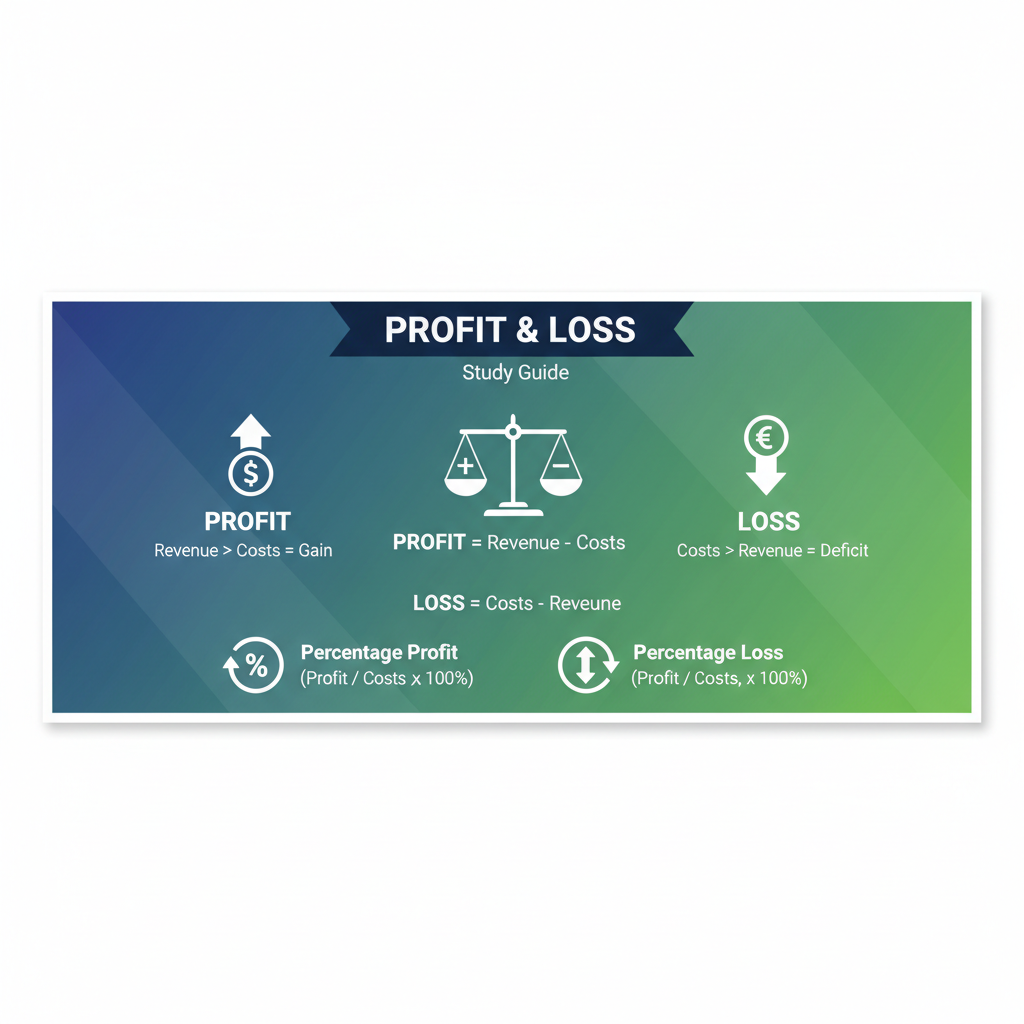
- Profit (Gain): When the Selling Price (SP) of an article is greater than its Cost Price (CP), the seller makes a profit.
- Profit = SP – CP
Condition:* SP > CP
- Loss: When the Selling Price (SP) of an article is less than its Cost Price (CP), the seller incurs a loss.
- Loss = CP – SP
Condition:* CP > SP
- Profit Percentage (Gain %): This expresses the profit as a percentage of the Cost Price. It’s crucial to remember that profit percentage is always calculated on the Cost Price unless stated otherwise.
- Profit % = (Profit / CP) × 100
- Profit % = [(SP – CP) / CP] × 100
- Loss Percentage (Loss %): This expresses the loss as a percentage of the Cost Price. Similarly, loss percentage is also always calculated on the Cost Price unless stated otherwise.
- Loss % = (Loss / CP) × 100
- Loss % = [(CP – SP) / CP] × 100
- Overhead Expenses: These are additional expenses incurred after purchasing an article but before selling it. This could include transportation costs, repair costs, labour charges, insurance, etc. These expenses are added to the initial Cost Price to arrive at the effective Cost Price.
- Effective CP = Purchase Price + Overhead Expenses
Example:* A forester buys logs for ₹10,000. He spends ₹500 on transportation and ₹200 on processing. His effective CP is ₹10,000 + ₹500 + ₹200 = ₹10,700.
- Marked Price (MP) / List Price: This is the price printed on the label of an article, or the price at which it is intended to be sold. It’s often higher than the Cost Price to allow for discounts and still make a profit.
Relationship:* MP >= SP >= CP (typically)
- Discount: A reduction offered on the Marked Price of an article. Discounts are always calculated on the Marked Price.
- Discount = Marked Price – Selling Price
- Discount % = (Discount / Marked Price) × 100
- Selling Price = Marked Price – Discount
- Selling Price = Marked Price × (100 – Discount %) / 100
Key Formulas and Relationships (Exam Focus)
Here’s a consolidated list of formulas, optimized for quick recall during exams.
- If there is a Profit:
- SP = CP × (100 + Profit %) / 100
- CP = SP × 100 / (100 + Profit %)
- If there is a Loss:
- SP = CP × (100 – Loss %) / 100
- CP = SP × 100 / (100 – Loss %)
- Relationship between CP, SP, MP, and Discount:
- SP = MP × (100 – Discount %) / 100
- If there is a profit after discount: CP × (100 + Profit %) / 100 = MP × (100 – Discount %) / 100
- If there is a loss after discount: CP × (100 – Loss %) / 100 = MP × (100 – Discount %) / 100
Important Concepts for Competitive Exams
- Always Calculate on CP: Unless explicitly stated, profit and loss percentages are always calculated with respect to the Cost Price. If a question mentions “profit on selling price,” then only calculate it on the SP. Otherwise, assume CP as the base.
- Successive Discounts: When multiple discounts are offered, they are applied one after another.
- If discounts are D1% and D2%, the final SP = MP × (100 – D1)/100 × (100 – D2)/100.
- The single equivalent discount = [D1 + D2 – (D1 × D2)/100]%
- False Weights / Dishonest Dealer: This is a common tricky question type. A shopkeeper uses a faulty balance to either gain extra profit or cheat the customer.
- Formula for Profit % = [(Error / True Weight – Error) × 100]%
- Here, Error = True Weight – False Weight.
Example:* A shopkeeper pretends to sell at cost price but uses a 900g weight instead of 1kg.
- True weight = 1000g, False weight = 900g.
- Error = 1000 – 900 = 100g.
- Profit % = (100 / (1000 – 100)) × 100 = (100 / 900) × 100 = 11 1/9 %.
- Buying X articles for ₹Y and Selling Y articles for ₹X:
- If CP of X articles = ₹Y and SP of Y articles = ₹X.
- To equalize, find the LCM of X and Y. Let it be N.
CP of N articles = N/X Y
SP of N articles = N/Y X
- Then calculate profit/loss based on CP and SP of N articles.
- Shortcut: If (CP of X articles = ₹Y) and (SP of Y articles = ₹X), then
- Profit/Loss % = [(X² – Y²) / Y²] × 100.
- If X² > Y², it’s a profit. If X² < Y², it's a loss.
- Two Articles, Same Selling Price, One Profit, One Loss:
If two articles are sold at the same Selling Price (SP), and one is sold at a P% profit while the other is sold at a P% loss, there is always* a loss.
- Net Loss % = (P²/100)%
This formula is quick, but only applicable when the percentage of profit and loss are numerically equal and applied on the same* selling price.
- Trading at a certain percentage less/more than expected:
- E.g., A seller marks his goods 20% above CP and offers a 10% discount.
- Let CP = ₹100.
- MP = ₹100 + 20% of ₹100 = ₹120.
- SP = MP – 10% of MP = ₹120 – 10% of ₹120 = ₹120 – ₹12 = ₹108.
- Profit = SP – CP = ₹108 – ₹100 = ₹8.
- Profit % = (8/100) × 100 = 8%.
Strategies for Solving Profit and Loss Problems
- Read Carefully: Identify what is given (CP, SP, Profit/Loss amount, percentages, discount, etc.) and what needs to be found. Pay attention to keywords like “on cost price,” “on selling price,” “marked up by,” “discounted by.”
- Assume a Base (Often ₹100): When percentages are involved and no absolute values are given, assuming CP = ₹100 or ₹1000 can simplify calculations and make it easier to understand the relationships.
- Work Step-by-Step: Break down complex problems into smaller, manageable steps. For example, if there’s a markup and then a discount, calculate the MP first, then the SP.
- Unitary Method / Ratios: For problems involving multiple articles or varying prices, the unitary method or setting up ratios can be very effective.
- Practice Mental Math: Many calculations in Profit and Loss involve percentages and fractions that can be done quickly mentally, saving precious exam time. For example, 20% of 300 is 60 (300/5), 25% is 1/4th, 10% is 1/10th.
Examples and Solved Problems
Let’s illustrate these concepts with examples relevant to competitive exams.
Example 1: Basic Profit/Loss Calculation
A forester bought 500 plants for ₹20,000. Due to heavy rains, 50 plants perished. He sold the remaining plants at ₹50 each. What was his profit or loss percentage?
- Step 1: Calculate Effective CP.
Total cost of 500 plants = ₹20,000.
Since 50 plants perished, the actual cost is now spread over fewer plants.
Number of plants remaining = 500 – 50 = 450 plants.
The effective Cost Price for each surviving plant (if we consider individual plant CP) has increased, or we can consider the total CP of ₹20,000 against the sale of 450 plants. Let’s take the latter approach as it’s simpler.
Total CP = ₹20,000.
- Step 2: Calculate Total SP.
Number of plants sold = 450.
Selling price per plant = ₹50.
Total SP = 450 × ₹50 = ₹22,500.
- Step 3: Determine Profit or Loss.
SP (₹22,500) > CP (₹20,000), so there is a Profit.
Profit = SP – CP = ₹22,500 – ₹20,000 = ₹2,500.
- Step 4: Calculate Profit Percentage.
Profit % = (Profit / CP) × 100
Profit % = (₹2,500 / ₹20,000) × 100
Profit % = (1/8) × 100 = 12.5%
Answer: The forester made a profit of 12.5%.
Example 2: Discount and Profit/Loss
A shopkeeper marks an axe at ₹2500. He offers a 10% discount on it. If he still makes a profit of 25%, what is the cost price of the axe?
- Step 1: Calculate Selling Price (SP).
Marked Price (MP) = ₹2500.
Discount = 10%.
SP = MP × (100 – Discount %) / 100
SP = ₹2500 × (100 – 10) / 100
SP = ₹2500 × 90 / 100
SP = ₹25 × 90 = ₹2250.
- Step 2: Calculate Cost Price (CP).
SP = ₹2250.
Profit % = 25%.
CP = SP × 100 / (100 + Profit %)
CP = ₹2250 × 100 / (100 + 25)
CP = ₹2250 × 100 / 125
CP = ₹2250 × 4 / 5 (since 100/125 = 4/5)
CP = ₹450 × 4 = ₹1800.
Answer: The Cost Price of the axe is ₹1800.
Example 3: Dishonest Dealer / False Weights
A seller, claiming to sell goods at cost price, uses a weight of 960 grams instead of 1 kilogram. Find his actual profit percentage.
- Step 1: Identify True Weight and False Weight.
True Weight = 1 kg = 1000 grams.
False Weight = 960 grams.
- Step 2: Apply the False Weight formula.
Error = True Weight – False Weight = 1000 – 960 = 40 grams.
Profit % = [(Error / (True Weight – Error)) × 100]%
Profit % = [(40 / (1000 – 40)) × 100]%
Profit % = [(40 / 960) × 100]%
Profit % = (1/24) × 100%
Profit % = 100/24 % = 25/6 % = 4 1/6 %
Answer: The seller’s actual profit percentage is 4 1/6 %.
Example 4: Buying X for Y, Selling Y for X
A person buys 11 mangoes for ₹10 and sells 10 mangoes for ₹11. Find the profit or loss percentage.
- Method 1: Equalize the number of articles.
CP of 11 mangoes = ₹10
SP of 10 mangoes = ₹11
To compare, find the LCM of 11 and 10, which is 110.
CP of 110 mangoes = (10/11) × 110 = ₹100
SP of 110 mangoes = (11/10) × 110 = ₹121
Since SP (₹121) > CP (₹100), there is a profit.
Profit = ₹121 – ₹100 = ₹21.
Profit % = (21/100) × 100 = 21%.
- Method 2: Using the shortcut formula.
X = 11 (number of articles bought for ₹Y)
Y = 10 (price for X articles / number of articles sold for ₹X)
Profit/Loss % = [(X² – Y²) / Y²] × 100
Profit/Loss % = [(11² – 10²) / 10²] × 100
Profit/Loss % = [(121 – 100) / 100] × 100
Profit/Loss % = (21 / 100) × 100 = 21%.
Since the result is positive, it’s a profit.
Answer: The person makes a profit of 21%.
Practice Questions (Self-Assessment)
- A forest department buys timber worth ₹1,20,000. They spend ₹5,000 on transportation and ₹3,000 on polishing. If they want to make a 20% profit, at what price should they sell the timber?
- An old sapling planter was sold for ₹4800, incurring a loss of 20%. For how much should it have been sold to gain a profit of 10%?
- A retailer marks his goods 30% above the Cost Price and offers a discount of 15%. What is his profit percentage?
- By selling 33 meters of fabric, a merchant gains the selling price of 11 meters. Find his profit percentage. (Hint: Let SP of 1 meter = ₹1)
- A grocer sells rice at a profit of 5% but uses weights that are 20% less than the actual weight. Find his total profit percentage.
- Two plant nurseries sold a rare plant species for ₹6500 each. One nursery made a profit of 25%, while the other incurred a loss of 25%. What is the overall profit or loss percentage for both nurseries combined?
- A shopkeeper bought 20 axes for ₹4000. He sold 12 axes at a profit of 20% and the remaining 8 axes at a loss of 10%. Find his overall profit or loss percentage.
Frequently Asked Questions (FAQs)
Q1: Why is profit/loss percentage always calculated on CP unless stated otherwise?
A1: The Cost Price represents the initial investment. Therefore, percentage gain or loss is traditionally measured against this initial investment to determine the return on that investment. It’s a standard business practice for consistency.
Q2: What is the difference between Marked Price (MP) and Selling Price (SP)?
A2: Marked Price (or List Price) is the advertised price or the price printed on the article. Selling Price is the actual price at which the article is sold after any discounts have been applied.
Q3: How do I handle questions with successive discounts?
A3: Apply the discounts one after another. If there’s a 10% discount and then a 20% discount, calculate the price after the first 10% discount, and then apply the 20% discount on that reduced price. Alternatively, use the equivalent single discount formula: D1 + D2 – (D1*D2)/100.
Q4: In dishonest dealer problems, why do we use (True Weight – Error) in the denominator for profit percentage?
A4: The dishonest dealer effectively sells a false weight quantity for the price of a true weight quantity. So, the profit is made on the cost of the false weight supplied. In simpler terms, he is taking money for 1000g but giving only 960g. His actual ‘investment’ (cost) is for 960g, while he charges for 1000g. The profit is (1000-960) on 960g.
Q5: What if overhead expenses are mentioned in a problem?
A5: Always add overhead expenses to the initial purchase price to get the effective Cost Price before calculating profit or loss. This revised CP is then used for all profit/loss calculations.
Q6: What is a useful trick for quickly calculating percentages?
A6:
- 10% of a number: Move decimal one place left. (e.g., 10% of 250 = 25)
- 1% of a number: Move decimal two places left. (e.g., 1% of 250 = 2.5)
- 50% = 1/2, 25% = 1/4, 20% = 1/5, 10% = 1/10. Knowing these fractional equivalents can speed up calculations significantly.
- For example, to find 15% of 300: (10% of 300) + (5% of 300) = 30 + 15 = 45.
Conclusion
Profit and Loss is a highly scoring topic in competitive exams like JKSSB Forester if you have a strong conceptual understanding and practice regularly. Remember the core definitions, the importance of Cost Price as the base for percentages, and the specific formulas for tricky scenarios like dishonest dealers or buying/selling different quantities. Consistent practice with a variety of problems, coupled with a systematic approach, will help you master this essential mathematical concept and boost your exam scores. Keep practicing, and success will surely follow!
