
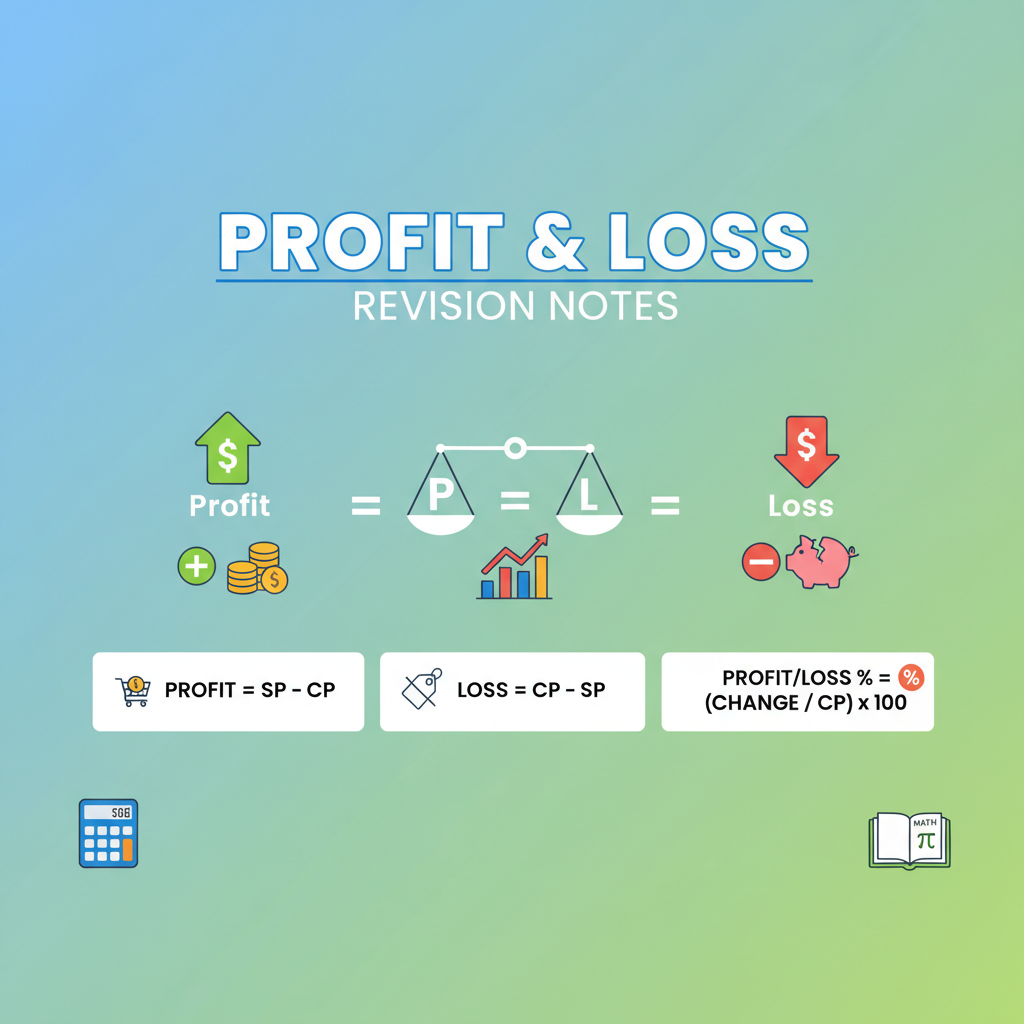
Profit and Loss is a fundamental topic in Mathematics for competitive exams like JKSSB. It deals with concepts of buying and selling, and calculating gains or losses incurred. A strong understanding of these principles is crucial for scoring well.
Core Concepts & Terminology
- Cost Price (CP): The actual price at which an article is purchased. This includes production costs, transportation, etc.
- Selling Price (SP): The price at which an article is sold.
- Profit (Gain): When the Selling Price is greater than the Cost Price (SP > CP).
- Loss: When the Selling Price is less than the Cost Price (SP < CP).
- Profit Percentage (Profit %): Profit expressed as a percentage of the Cost Price.
- Loss Percentage (Loss %): Loss expressed as a percentage of the Cost Price.
- Marked Price (MP) / List Price: The price at which an article is listed for sale, often higher than the CP to allow for discounts.
- Discount: A reduction offered on the Marked Price.
Overhead Expenses: Additional costs incurred after purchasing an item (e.g., transportation, repairs, installation). These are always* added to the Cost Price.
Fundamental Formulas
1. Profit/Loss Calculation:
- Profit = SP – CP (if SP > CP)
- Loss = CP – SP (if CP > SP)
2. Profit/Loss Percentage:
- Profit % = (Profit / CP) × 100
- Loss % = (Loss / CP) × 100
Key Highlight: Profit or Loss Percentage is always calculated on the Cost Price, unless otherwise specified.
3. Finding SP when CP and Profit/Loss % are given:
- If Profit % (P%) is given: SP = CP × (100 + P%) / 100
- If Loss % (L%) is given: SP = CP × (100 – L%) / 100
4. Finding CP when SP and Profit/Loss % are given:
- If Profit % (P%) is given: CP = SP × 100 / (100 + P%)
- If Loss % (L%) is given: CP = SP × 100 / (100 – L%)
Mnemonic:
- “Buying Low, Selling High is a WHY-IGH (HIgh) Percent!” (Profit: SP is High, (100 + P%) in numerator for SP, denominator for CP)
- “Buying High, Selling Low is a LO-SS!” (Loss: SP is Low, (100 – L%) in numerator for SP, denominator for CP)
Discounts & Marked Price
- Discount = Marked Price (MP) – Selling Price (SP)
- Discount % = (Discount / MP) × 100
Relationship:
- SP = MP × (100 – Discount %) / 100
- MP = SP × 100 / (100 – Discount %)
Key Highlight: Discount is always calculated on the Marked Price.
Important Scenarios & Advanced Concepts
1. Consecutive Discounts:
If an article is sold at two successive discounts of D1% and D2%, the Effective Discount is not simply D1 + D2.
- Effective Discount = D1 + D2 – (D1 × D2) / 100
Example: Two successive discounts of 10% and 20% on an item.
Effective Discount = 10 + 20 – (10 × 20) / 100 = 30 – 2 = 28%.
This means the item is sold at 72% of its Marked Price.
2. Profit/Loss when an item is sold at a certain profit/loss percentage:
If an item is sold at a Profit of P% and then again at a Loss of L%, the CP remains constant. The SP changes.
These problems often involve comparing two selling prices.
Strategy: Calculate SP1 and SP2 using the ratio method or direct formula (CP is constant).
3. When multiple articles are sold at the same price:
- Case 1: Same SP, one with P%, another with L% (same magnitude).
If two articles are sold at the same Selling Price, one at a gain of x% and the other at a loss of x%, then there is always a loss.
Total Loss % = (x / 10)^2 (This is a shortcut, remember it applies only when the SPs are same and percentage gain/loss values are identical).
Example: A shopkeeper sells two TVs for Rs. 12,000 each. On one he gains 20% and on the other he loses 20%.
Total Loss % = (20/10)^2 = 2^2 = 4%.
Total SP = 12000 + 12000 = 24000.
Total CP = Total SP × 100 / (100 – Loss %) = 24000 × 100 / (100 – 4) = 24000 × 100 / 96 = Rs. 25,000.
Total Loss = 25000 – 24000 = Rs. 1,000.
- Case 2: Same CP, one with P%, another with L% (same magnitude).
If two articles are bought at the same Cost Price, one sold at P% profit and the other at P% loss, then there is neither profit nor loss on the whole transaction.
4. Dishonest Dealer (False Weights):
These problems are common. A dishonest dealer uses false weights to cheat customers.
- When a tradesman professes to sell his goods at CP, but uses false weights:
Gain % = (Error / (True Value – Error)) × 100
Where Error = (True Weight – False Weight Used).
Example: A dishonest shopkeeper sells goods at cost price but uses 800 gm weight instead of 1 kg (1000 gm).
Error = 1000 – 800 = 200 gm.
Gain % = (200 / (1000 – 200)) × 100 = (200 / 800) × 100 = (1/4) × 100 = 25%.
- When a tradesman marks up his goods, offers a discount, AND uses false weights:
This situation requires combining strategies.
Strategy: Assume CP of 1 unit of weight (e.g., 1 gm) is Re. 1.
If he sells x unit instead of y unit:
- His effective cost is for x units.
- His effective revenue is for y units (at marked/discounted price).
Combine the percentage profit from price markup/discount with the profit from false weight.
Formula for combined profit/loss (complex case):
Let M% be the markup % on CP.
Let D% be the discount % on MP.
Let the shopkeeper sell ‘w’ units instead of ‘W’ units (W > w).
Total Profit % = [( (100 + M – D – (MD/100)) / (W/w 100) ) – 1] 100 (This formula is complex, better to use chain method or unit method.)
Easier Approach (Chain Method):
- Assume CP of 1 unit = Re. 1.
- Calculate profit/loss due to markup/discount on the professed weight.
- Calculate profit/loss due to false weight from the actual weight sold.
Example: A dealer marks goods 10% above CP and gives 10% discount, but uses 800g instead of 1kg.
Let CP of 1g = Re. 1. So CP of 1000g = Rs. 1000.
- Mark up & Discount:
Marked Price = 1000 + 10% of 1000 = Rs. 1100.
Selling Price after 10% discount = 1100 – 10% of 1100 = 1100 – 110 = Rs. 990.
So, for 1000g, he sells at Rs. 990. (This represents a 1% loss relative to true weight at CP)
- False Weight:
He sells 800g but charges for 1000g.
CP of 800g = Rs. 800.
He receives Rs. 990 (from step 1). But this Rs. 990 is for the 800g actually sold.
So, Actual CP for goods sold = Rs. 800.
Actual SP for these goods = Rs. 990.
Profit = 990 – 800 = Rs. 190.
Profit % = (190 / 800) × 100 = (19/80) × 100 = 190/8 = 23.75%.
5. Articles BOUGHT & SOLD (Interchange of quantities and prices):
When a person buys ‘x’ articles for ‘y’ rupees and sells ‘y’ articles for ‘x’ rupees.
Let’s say:
- Buys A articles for Rs. B
- Sells B articles for Rs. A
Strategy: Make the number of articles equal. Find CP and SP for the same number of articles.
- CP of A articles = Rs. B
- SP of B articles = Rs. A
To make articles equal (LCM of A and B):
- CP of AB articles = B × B = Rs. B^2
- SP of AB articles = A × A = Rs. A^2
- Profit % = ((A^2 – B^2) / B^2) × 100 (if A^2 > B^2)
- Loss % = ((B^2 – A^2) / B^2) × 100 (if B^2 > A^2)
Example: A man buys 10 oranges for Rs. 11 and sells 11 oranges for Rs. 10.
Here, A = 10, B = 11 (incorrect application from formula above, be careful!)
Let’s use the method:
CP of 10 oranges = Rs. 11
SP of 11 oranges = Rs. 10
LCM of 10 & 11 is 110.
CP of 110 oranges = (11/10) × 110 = Rs. 121
SP of 110 oranges = (10/11) × 110 = Rs. 100
Since SP < CP, there is a loss.
Loss = 121 – 100 = Rs. 21.
Loss % = (21 / 121) × 100 = 17.35%.
6. Mean Proportion / Average Profit/Loss:
When different items are bought or sold at different profit/loss percentages, and you need to find the overall profit/loss.
Strategy: Calculate total CP and total SP.
Example: A person buys two articles. One at Rs. 500, sold at 10% profit. Other at Rs. 300, sold at 5% loss.
Total CP = 500 + 300 = Rs. 800.
SP of 1st article = 500 + 10% of 500 = 500 + 50 = Rs. 550.
SP of 2nd article = 300 – 5% of 300 = 300 – 15 = Rs. 285.
Total SP = 550 + 285 = Rs. 835.
Total Profit = 835 – 800 = Rs. 35.
Overall Profit % = (35 / 800) × 100 = 35/8 = 4.375%.
Key Highlights & Strategies for Problem Solving
- Understand the reference point: Profit/Loss % is always on CP, Discount % is always on MP.
- Unitary Method: Often, assume CP = 100 or MP = 100 to quickly calculate percentages.
- Ratio Method: Convert percentages to fractions for faster calculations (e.g., 20% profit = 1/5 profit, so if CP is 5, Profit is 1, SP is 6. CP:SP = 5:6).
- CP : SP = 100 : (100 + P%)
- CP : SP = 100 : (100 – L%)
- MP : SP = 100 : (100 – D%)
- Chain Rule: For multiple operations (e.g., CP -> Marked Up -> Discount -> Profit/Loss). This can be visualised as:
CP -> (+Markup%) -> MP -> (-Discount%) -> SP
Or, if you find CP to SP relation:
SP = CP (100+M)/100 (100-D)/100 (where M is markup % on CP, D is discount % on MP) – this only works if markup is explicitly on CP and discount on MP to directly get SP relative to CP.
- Fractions and Decimals: Be comfortable converting between them.
- e.g., 16 2/3 % = 1/6
- 12.5% = 1/8
- 10% = 1/10
- 20% = 1/5
- 25% = 1/4
- Read Carefully: Identify what is given (CP, SP, MP, Profit%, Loss%, Discount%). Check for “on whole transaction” or “on individual items.”
- Overhead Expenses: Remember to add these to the Cost Price.
- Approximation: In MCQ, sometimes approximating can save time, especially with percentage calculations. However, be careful if options are very close.
Reverse Calculation: If you need to find CP from SP and percentage, use the inverse formulas. Example: SP = CP (100+P)/100 => CP = SP * 100/(100+P).
Common Pitfalls to Avoid
- Not differentiating between Profit/Loss % and Discount % bases: Profit/Loss is on CP, Discount is on MP.
- Calculating Discount on CP: A major error.
- Adding/subtracting percentages directly: E.g., a 10% gain and a 10% loss do NOT cancel out to zero when applied sequentially or on different bases. (Remember the (x/10)^2 loss rule for same SP and same % gain/loss).
Ignoring Overhead Expenses: These always* increase CP.
- Misinterpreting “sells a certain % more/less on CP”: This often indicates a false weight problem.
- Confusing buying price and selling price in ‘articles for rupees’ problems.
Practice Table: Percentage Equivalents
| Percentage | Fraction | Decimal | Application (CP to SP) |
|---|---|---|---|
| 10% Profit | +1/10 | 1.1 | SP = CP (11/10) |
| 10% Loss | -1/10 | 0.9 | SP = CP (9/10) |
| 20% Profit | +1/5 | 1.2 | SP = CP (6/5) |
| 20% Loss | -1/5 | 0.8 | SP = CP (4/5) |
| 25% Profit | +1/4 | 1.25 | SP = CP (5/4) |
| 25% Loss | -1/4 | 0.75 | SP = CP (3/4) |
| 33 1/3% Profit | +1/3 | 1.333… | SP = CP (4/3) |
| 33 1/3% Loss | -1/3 | 0.666… | SP = CP (2/3) |
| 16 2/3% Profit | +1/6 | 1.166… | SP = CP (7/6) |
| 16 2/3% Loss | -1/6 | 0.833… | SP = CP (5/6) |
| 12.5% Profit | +1/8 | 1.125 | SP = CP (9/8) |
| 12.5% Loss | -1/8 | 0.875 | SP = CP (7/8) |
This comprehensive revision note covers the essential aspects of Profit & Loss for your JKSSB Forester exam. Focus on understanding the core concepts and practicing various problem types. Good luck!
