
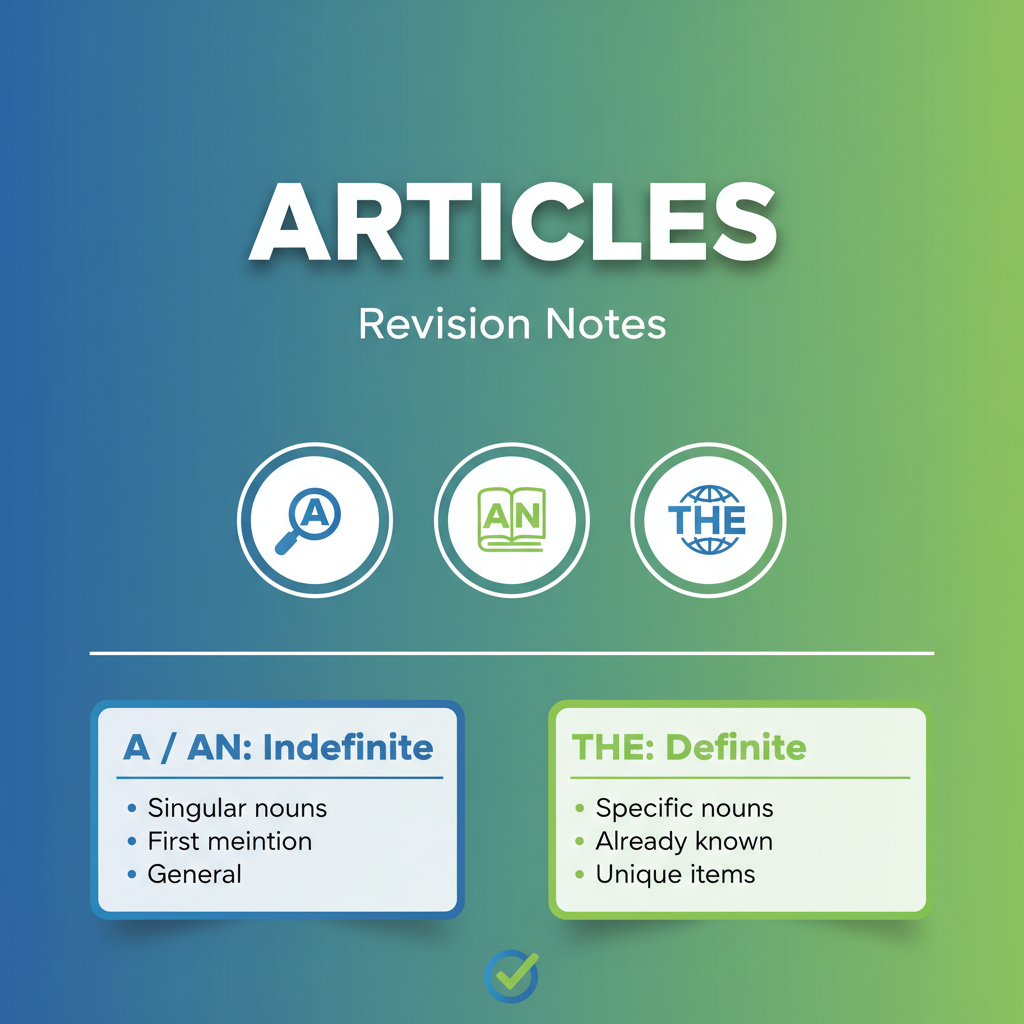
Here are concise revision notes on Articles, specifically tailored for competitive exams like JKSSB, designed for easy revision and incorporating various learning aids.
English Grammar: Articles (A, An, The) – Revision Notes
Subject: English Grammar
Topic: Articles (Determiners)
Exam Context: JKSSB & other Indian Competitive Exams
Key Highlights & Mnemonics
- Articles are a type of Determiner. They always come before a noun (or a word modifying a noun).
- A/An = Indefinite Articles: Refer to a non-specific or general item. Think of “any” or “one of many.”
- The = Definite Article: Refers to a specific or particular item. Think of “that one” or “the only one.”
- Mnemonic for Usage:
- A/An: Any-one, All-the-rest (non-specific)
- The: That-specific-one, The-only-one (specific)
Sound, Not Spelling! The choice between ‘a’ and ‘an’ depends on the sound* of the first letter of the following word, not its spelling.
- Count vs. Non-Count Nouns:
- ‘A/An’ are used only with singular countable nouns.
- ‘The’ can be used with singular, plural, countable, and uncountable nouns.
I. Introduction to Articles
- Articles are words that define whether a noun is specific or unspecific.
- They are part of a larger class of words called Determiners.
- Types of Articles:
- Indefinite Articles: a, an
- Definite Article: the
II. Indefinite Articles: ‘A’ and ‘An’
- Used to refer to non-specific, general, or unidentified nouns.
- They indicate that the noun is one of many or any of that type.
- Always used with singular countable nouns.
A. Usage of ‘A’
- Used before singular countable nouns that begin with a consonant sound.
- Examples:
- a book (b sound)
- a cat (c sound)
- a chair (ch sound)
- a university (yoo sound, although ‘u’ is a vowel)
- a European (yoo sound, although ‘E’ is a vowel)
- a one-rupee note (wuh sound, although ‘o’ is a vowel)
- a high school (h sound)
- a useful tool (yoo sound)
B. Usage of ‘An’
- Used before singular countable nouns that begin with a vowel sound (a, e, i, o, u).
- Examples:
- an apple (a sound)
- an elephant (e sound)
- an inkpot (i sound)
- an orange (o sound)
- an umbrella (u sound)
- an hour (ow sound, ‘h’ is silent)
- an honest man (ow sound, ‘h’ is silent)
- an MLA (em sound, ‘M’ starts with a vowel sound)
- an X-ray (eks sound, ‘X’ starts with a vowel sound)
- an UPSC aspirant (yoo-pee-es-see, but the initial ‘U’ sounds like ‘uh’ rather than ‘yoo’, hence ‘an’)
C. Key Rules for ‘A’ and ‘An’
- First Mention: When you introduce a singular countable noun for the first time.
Example:* I saw a dog yesterday. (Any dog)
- Occupations/Professions:
Example:* She is a doctor. He wants to be an engineer.
- Classes/Categories: To represent a class of things.
Example:* A cow is a useful animal.
- Expressions of Quantity or Frequency:
Example:* I have a few books. He earns ₹50,000 a month.
- Exclamations with Singular Countable Nouns:
Example:* What a beautiful flower! What an amazing view!
- Certain Illnesses (non-serious):
Example:* He has a cold. She got a headache. (But typically “flu,” “measles” use ‘the’ or no article, consult medical terms)
- To Mean “One”:
Example:* Give me a pen. (meaning one pen)
D. Common Errors & Clarifications for ‘A’ and ‘An’
- Silent ‘H’: If ‘h’ is silent, use ‘an’. (an hour, an honest man)
- Sound of ‘U’:
- If ‘u’ sounds like ‘yoo’, use ‘a’. (a university, a useful book)
- If ‘u’ sounds like ‘uh’, use ‘an’. (an umbrella, an umpire)
- Sound of ‘O’:
- If ‘o’ sounds like ‘wuh’, use ‘a’. (a one-eyed man)
- Otherwise, use ‘an’. (an orange)
Acronyms/Abbreviations: Rely on the sound of the first letter* when pronounced individually.
Example:* an MBA (em-bee-ay), an S.P. (es-pee), but a NASA scientist (nah-sah)
III. Definite Article: ‘The’
- Used to refer to a specific, particular, or already identified noun.
- Indicates that the listener/reader knows exactly which person, place, or thing is being talked about.
- Can be used with singular, plural, countable, and uncountable nouns.
A. Key Rules for ‘The’
- Second Mention (and subsequent): When a noun that was previously indefinite becomes definite.
Example:* I saw a dog yesterday. The dog was very friendly.
- Unique/Only One: When there is only one of something in the world or in the immediate context.
Example:* The sun rises in the east. The Earth revolves around the sun. The President of India.
- Superlative Degrees of Adjectives:
Example:* He is the tallest boy in the class. This is the most interesting book I’ve ever read.
- Ordinal Numbers: (First, second, third, last, next, only)
Example:* The first chapter. The last bus. The next time.
- Specific Groups of People/Nationalities:
Example:* The rich should help the poor. The English are known for their politeness.
- Musical Instruments:
Example:* He plays the guitar. She loves the piano.
- Before Adjectives to Represent a Class:
Example:* The brave deserve respect.
- Well-Known Buildings, Landmarks, Monuments:
Example:* The Taj Mahal, The Eiffel Tower, The Red Fort.
- Rivers, Seas, Oceans, Mountain Ranges, Deserts, Groups of Islands:
Example:* The Ganga, The Pacific Ocean, The Himalayas, The Sahara Desert, The Andaman and Nicobar Islands. (But not individual mountains or lakes: Mount Everest, Dal Lake)
- Holy Books/Scriptures:
Example:* The Bhagavad Gita, The Quran, The Bible.
- Newspapers & Magazines (specific titles):
Example:* The Times of India, The Guardian.
- Ships, Trains, Airplanes (specific names):
Example:* The Titanic, The Rajdhani Express.
- Plural Names of Countries/States: (But not singular names unless they contain a common noun)
Example:* The United States, The Netherlands, The United Arab Emirates. (But: India, France, Jammu and Kashmir – no ‘the’)
- Before Common Nouns to Provide Emphasis/Uniqueness:
Example:* This is the product I was looking for. (Meaning, the specific one)
B. The Definite Article with Uncountable Nouns
- ‘The’ is used when referring to a specific quantity or type of uncountable noun.
Example:* Please pass the sugar. (Specific sugar on the table)
Compare:* Sugar is sweet. (General sugar – no article)
Example:* The water in this bottle is cold. (Specific water)
Compare:* Water is essential for life. (General water – no article)
C. Pronunciation of ‘The’
- Before consonant sound: /ðə/ (e.g., the book, the table)
- Before vowel sound: /ðiː/ (e.g., the apple, the honest man)
IV. Omission of Articles (Zero Article – No Article)
- This is as important as knowing when to use articles. Not using an article where one is required is a common error.
A. Key Rules for Zero Article
- General Plural Countable Nouns: When referring to things in general.
Example:* Dogs are loyal animals. (Not “The dogs are loyal animals” unless referring to specific dogs)
Example:* Children love to play.
- General Uncountable Nouns: When referring to concepts or substances in general.
Example:* Water is essential for life.
Example:* Knowledge is power.
Example:* Honesty is the best policy.
- Proper Nouns (Names of People, Single Countries, Cities, Continents):
Example:* Ram lives in Delhi. India is a diverse country. Asia is the largest continent.
Exceptions:* The United States, The Netherlands (as mentioned above)
- Meals (Breakfast, Lunch, Dinner): When referring to them generally.
Example:* We have dinner at 8 PM.
Exception:* If modified or specific: We had a fantastic dinner. The dinner last night was delicious.
- Languages:
Example:* He speaks English. She is learning French.
- Subjects of Study:
Example:* I study Mathematics. He is good at History.
- Sports and Games:
Example:* They play cricket. Do you like to play football?
- Diseases (most, but some specific ones take ‘the’ or indefinite articles):
Example:* He suffered from fever. She contracted malaria. (But: a cold, the flu, the measles)
- Before Nouns referring to Places like School, College, Church, Hospital, Prison, Temple, Bed, Court, Market, Office (when used for their primary purpose).
Example:* My children go to school. (for study)
Compare:* My father went to the school to meet the principal. (specific building, not for primary purpose)
Example:* He was sent to prison. (as a prisoner)
Compare:* I went to the prison to visit him. (specific building)
- Means of Transport (by bus, by car, by train, by air, by sea/land):
Example:* I go to work by bus.
Compare:* I took the bus to work. (Specific bus)
- Before Possessive Pronouns or Adjectives: (my, your, his, her, its, our, their, Ram’s, etc.) Articles do not stand with possessives.
Example:* This is my book. (Not “This is the my book”)
- Before Demonstratives: (this, that, these, those) Articles do not stand with demonstratives.
Example:* This book is interesting. (Not “This the book…”)
- Before Distributives: (each, every, either, neither)
Example:* Each student received a prize. (Not “The each student…”)
- Abstract Nouns (in general sense): (truth, beauty, freedom, happiness)
Example:* Freedom is a birthright.
Exception:* If specific: The freedom I felt was immense.
- Materials/Substances (in general sense): (gold, silver, wood, water)
Example:* Gold is a precious metal.
Exception:* If specific: The gold in her necklace was pure.
V. Special Cases & Exceptions (Table for Quick Reference)
| Category | Use ‘The’ | Don’t Use ‘The’ (Zero Article) |
|---|---|---|
| Continents | – (Never) | Asia, Europe, Africa |
| Countries | Plural names: The USA, The Netherlands, The UK | India, China, France, Germany (singular names) |
| States/Provinces | – (Never for most) | Jammu & Kashmir, Punjab, Uttar Pradesh |
| Cities | – (Never) | Mumbai, Delhi, London |
| Lakes | – (Never for individual) | Dal Lake, Wular Lake, Lake Superior |
| Mountains | Mountain ranges: The Himalayas, The Alps | Individual mountains: Mount Everest, Mount Fuji |
| Islands | Groups of islands: The Maldives, The Bahamas | Individual islands: Sicily, Sri Lanka |
| Roads/Streets | – (Never) | Main Street, MG Road, Gandhi Nagar |
| Public Places (Primary Purpose) | When specific building: The school, the church | When primary purpose: go to school, go to church |
| Directions | – (Never) | North, South, East, West (general) |
| Planets | – (Never) | Mars, Jupiter, Venus |
| Seasons | – (Typically) | Summer, Winter, Spring, Autumn |
| Illnesses | The flu, The measles | Fever, cold, cancer, malaria |
| Body Parts | – (Typically with possessives or verb phrase) | My head, his arm, a broken leg (not ‘the leg’) |
| Relations | – (Never when talking about own family) | Father, Mother, Brother, Sister |
VI. Practice Examples (Jkssb Style)
Directions: Choose the most appropriate article (a, an, the) or indicate where no article is needed (X).
- My brother is \_\_\_ engineer.
- \_\_\_ sun rises in \_\_\_ east.
- She plays \_\_\_ piano very well.
- \_\_\_ honest man is truly rich.
- What \_\_\_ beautiful sight!
- \_\_\_ knowledge is power.
- \_\_\_ Ganga is \_\_\_ holy river.
- I go to \_\_\_ school every day.
- He wants to study \_\_\_ history.
- This is \_\_\_ interesting book.
VII. Revision Checklist
- Understand the basic difference between definite and indefinite articles.
- Remember ‘a’ for consonant sound, ‘an’ for vowel sound.
- Be mindful of silent ‘H’ and varying ‘U’/’O’ sounds for ‘a’/’an’.
- Know ‘the’ for specifics, uniques, superlatives, ordinals, natural phenomena, and specific groups.
Crucially, identify situations where no article* is needed (zero article).
- Pay attention to general vs. specific use of nouns, especially uncountable and plural nouns.
- Practice identification errors related to articles.
This comprehensive guide covers articles with a focus on competitive exam relevance, making it an ideal resource for quick and effective revision. Remember to practice regularly to solidify your understanding.
